This is the multi-page printable view of this section. .
Posts
- 1: MinIO Fork, Promise Kept
- 2: MinIO Is Dead, Long Live MinIO
- 3: MinIO Is Dead. Which Next?
- 4: MinIO is Dead
Essays and analysis about MinIO, S3-compatible object storage, and the SILO community fork.
1 - MinIO Fork, Promise Kept
Two months ago in “MinIO is Dead, Long Live MinIO,” I promised I’d keep the MinIO fork patched. The recurring objection on HN is fair: can one person actually maintain something like this? The real answer isn’t clicking fork. It’s what happens when CVEs start landing.
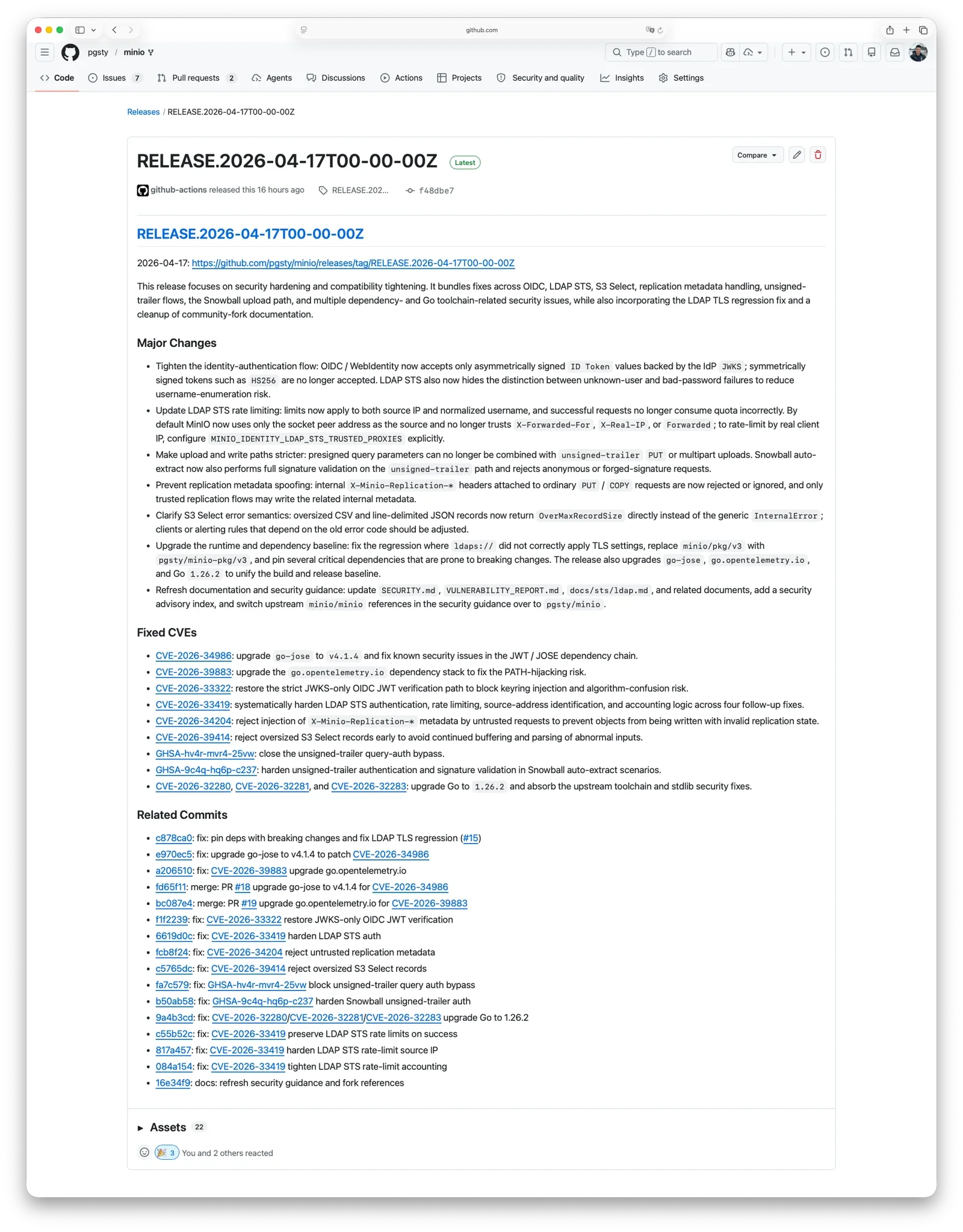
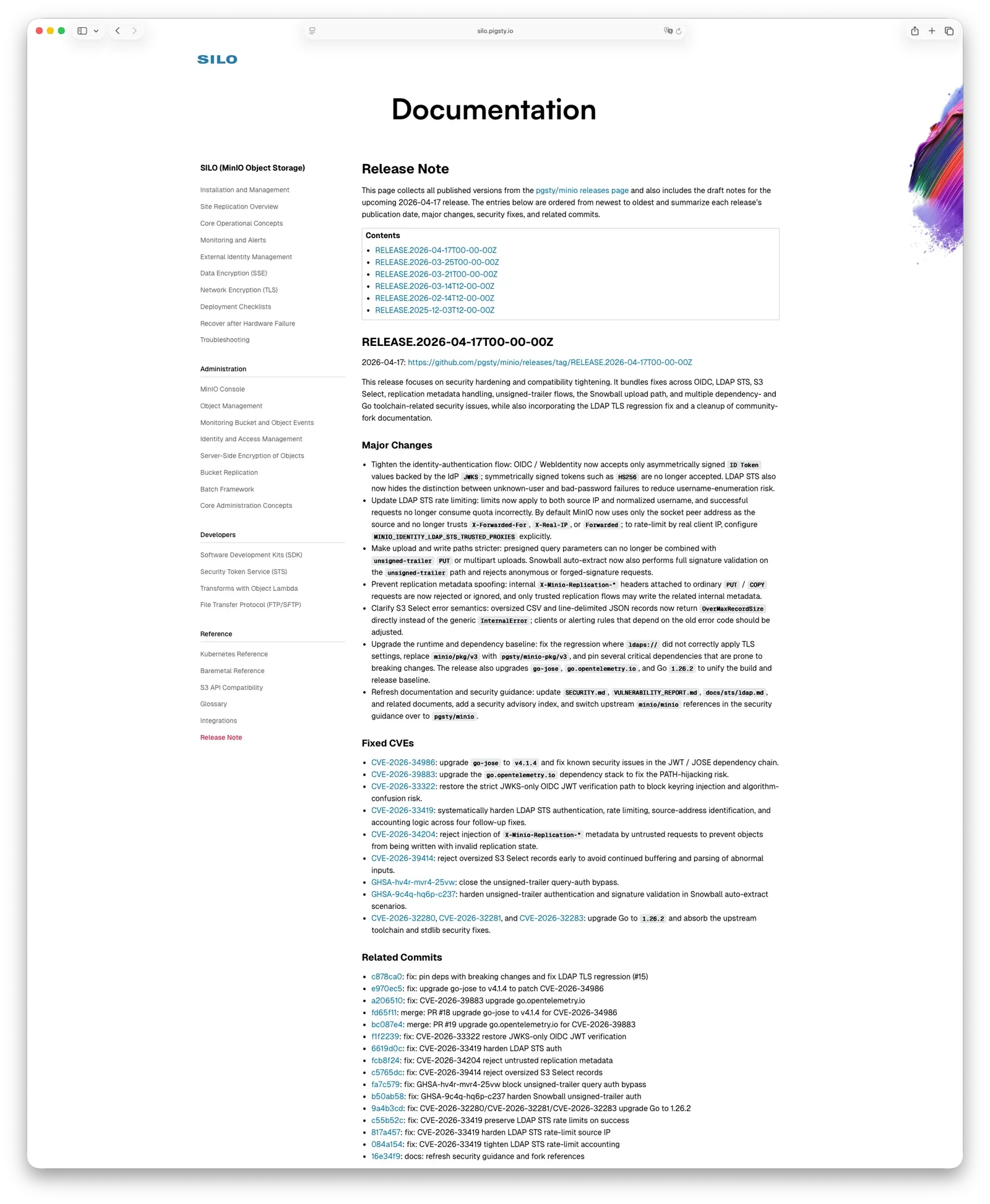
Between April 15 and 17, pgsty/minio shipped RELEASE.2026-04-17,
closing four CVEs and a handful of related vulnerabilities disclosed in the same window.
The scope I committed to originally was narrow: no new features, keep the supply chain running, handle reproducible bugs and security issues as they come in. This release is what it looks like when that promise gets tested.
What happened upstream
In December 2025, MinIO moved the open-source repo to maintenance mode. The README said security fixes would be “evaluated case by case.” In February 2026, the repository was archived and the landing page became “this repository is no longer maintained.”
The SECURITY.md in that same archived repo still says: “we will always provide security updates for the latest release.”
Over the past month, four high-severity and two medium-severity vulnerabilities have been disclosed against the final open-source release.
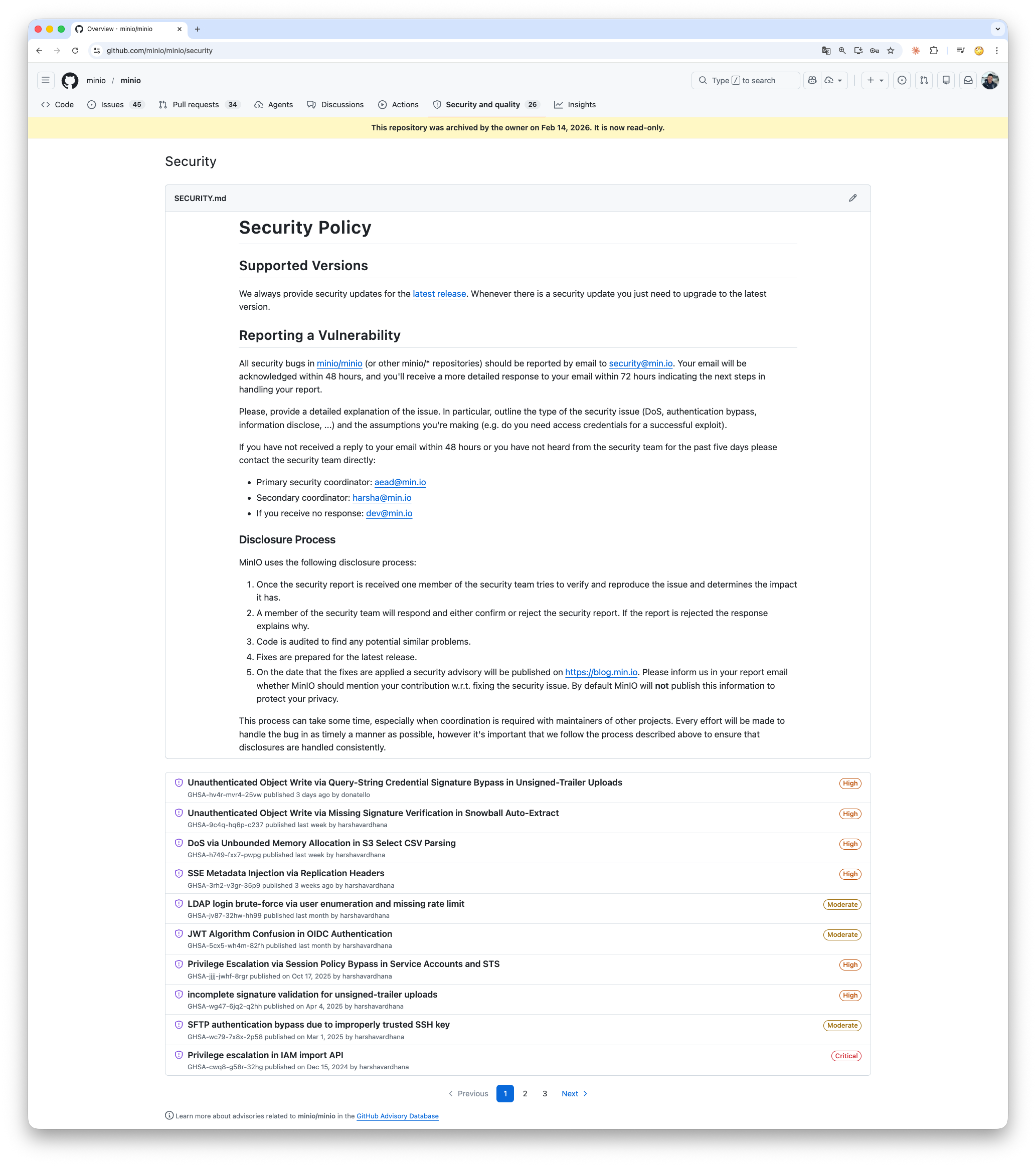
It’s been 184 days since the last upstream release. Vulnerabilities get disclosed; fixes ship only in the commercial build. The guidance for OSS users is a single line: upgrade to AIStor.
AIStor starts around $100k/year for 400 TiB — roughly S3 pricing, for software you install and operate yourself.
It’s a clean arrangement: archive the repo so there’s no obligation to patch, keep publishing CVE advisories for visibility, and route everyone who reads them toward the commercial product.
Someone still has to patch the old one.
What this release fixes
Full write-ups, CVSS arithmetic, and PoCs are in the release notes. The short version:
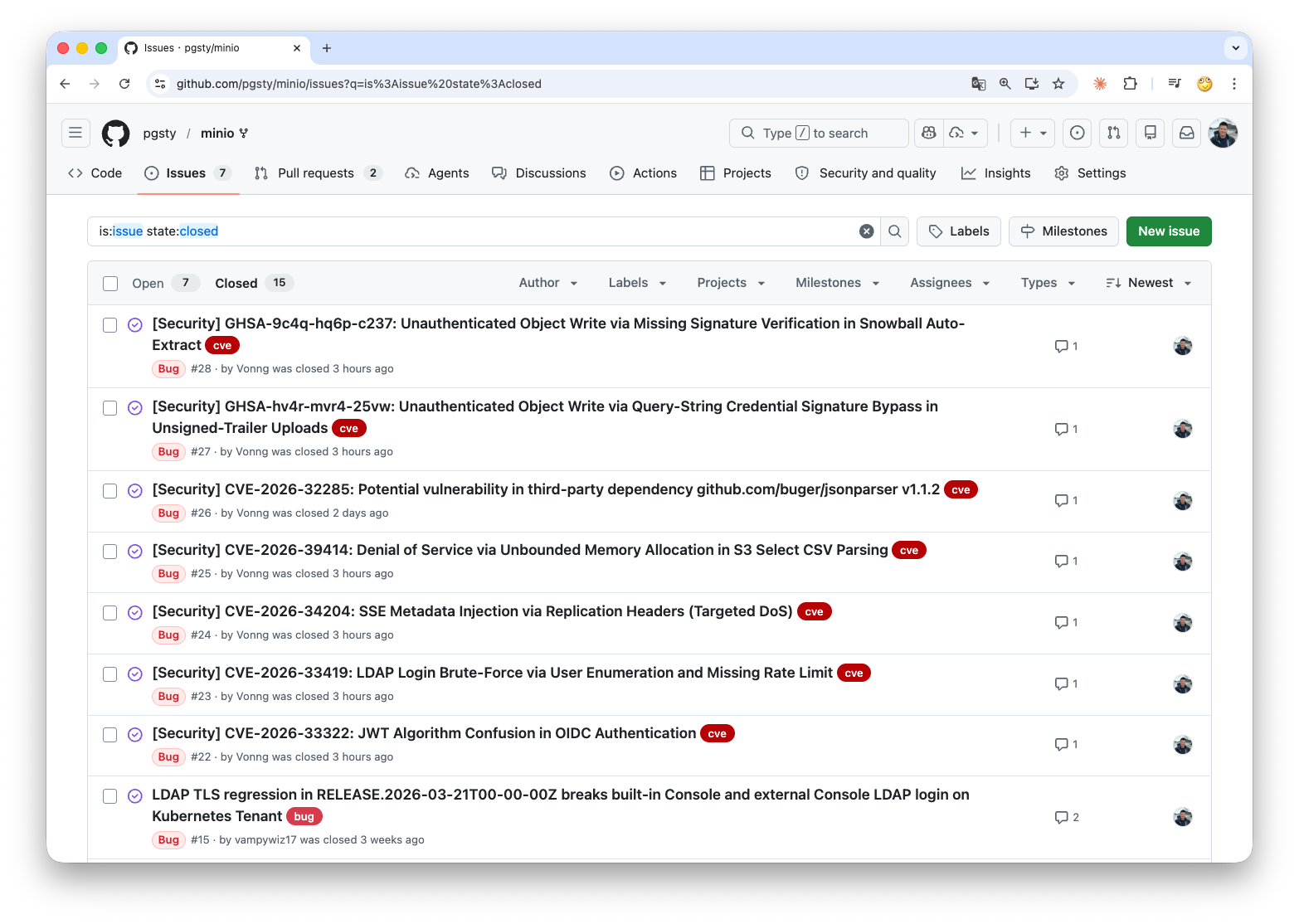
- CVE-2026-33322 (OIDC JWT algorithm confusion, CVSS 9.8): under certain IdP configurations, an attacker who knows the OIDC ClientSecret can mint a token claiming any identity — including
consoleAdmin— and MinIO will accept it. Vulnerable window: November 2022 through March 2026. About three and a half years. - CVE-2026-33419 (LDAP STS enumeration and brute-force): the login endpoint leaks which usernames are real, and there’s no rate limiting on the subsequent password guessing. End of the chain is an STS credential.
- CVE-2026-34204 (replication-header metadata injection): a regular PUT or COPY with certain
X-Minio-Replication-*headers can write an object into a permanently unreadable state. The data is still on disk; you just can’t read it back out. - CVE-2026-39414 (S3 Select memory exhaustion): one request, one OOM.
- GHSA-hv4r-mvr4-25vw / GHSA-9c4q-hq6p-c237: two signature-verification bypasses on the unsigned-trailer path. Anonymous or forged-signature requests can successfully write objects on certain routes.
Plus the usual dependency cleanup from go-jose, go.opentelemetry.io, and the Go 1.26.2 upgrade itself — about twenty security items in total counting transitive dependencies.
How it got fixed
I said in the earlier post that I’d rely on AI coding agents, and that’s how this round went. My role was closer to “review and decide” than “write code.”
Per-issue flow, roughly:
- Codex drafts first. Given the CVE description and relevant code paths, it produces an initial patch.
- Claude Code reviews adversarially. Picks holes from the attacker’s side.
- Back to Codex. If it agrees with Claude Code’s critique, it reworks. If not, it has to write out why. No silent overrides.
- Another round of review by Claude Code, with both sides’ reasoning on the table. Iterate until they converge.
- Tests. Codex proposes cases, Claude Code adds more, Codex runs them, Claude Code reviews the results.
- I decide. Read the diff, run the tests, merge or send it back with comments.
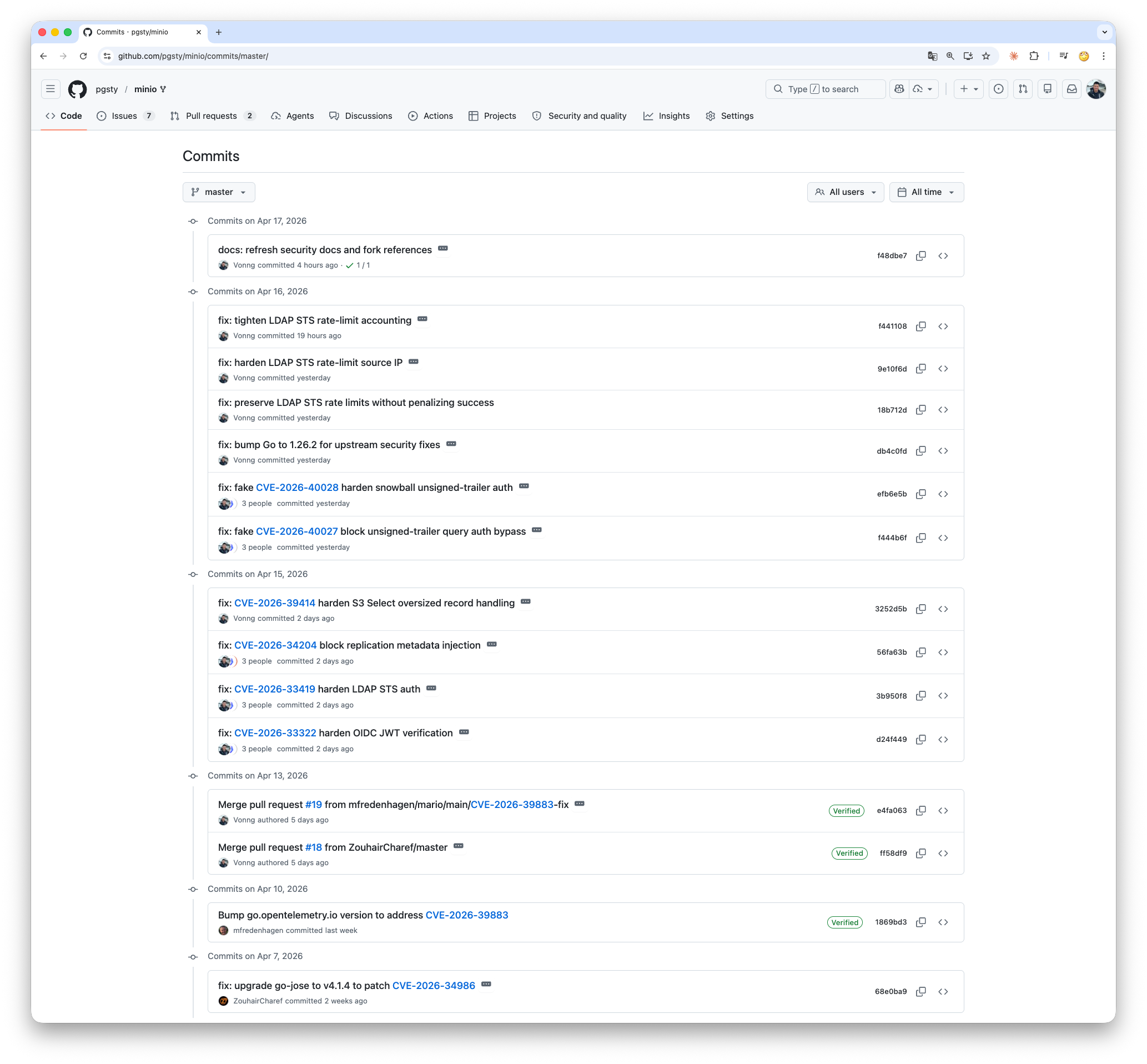
I didn’t write any of the code in this round. My job was to define the problem, set constraints, pick between approaches, read diffs, run tests, and merge. The GitHub log shows Vonng, Codex, and Claude Code as co-authors — that’s just who did the work.
A few things I noticed about how this runs in practice.
Two heterogeneous agents in opposition catch more than one agent alone. A single agent patching a security bug tends toward confident-sounding fixes that quietly miss a boundary condition. Having a second agent argue against the first filters out most of those.
It forces the tradeoffs into writing. When two implementations diverge, someone has to say why A over B. That exchange is the thing I can actually act on as the person deciding what to merge.
Real maintenance is patch-on-patch, not one-shot. The LDAP STS fix is a good example. The first version landed, and then we realized: successful requests shouldn’t count against the rate limit; X-Forwarded-For shouldn’t be trusted by default; the limiter should key on source IP plus normalized username, not just one. Three follow-up commits before it settled. Iterating through that by hand would have cost a lot more time.
Why this fork exists
Because I use MinIO myself.
MinIO is a production dependency for Pigsty. I need working binaries, a complete console, packages that keep shipping, and someone actually handling CVEs. That keeps the scope narrow. No new features, no turning the repo into a playground. Compatibility, supply chain, fixes when they’re needed.
— Chainguard also ships MinIO container images that track upstream’s post-archive commits, a useful option if you use their images. This fork is a different shape: source tree, RPM/DEB packages, restored console, and doesn’t depend on upstream continuing to push patches somewhere.
The fork is at about 1,300 stars on GitHub and 50,000+ pulls on Docker Hub now. Not remarkable numbers, but enough to tell me I’m not the only one who needed this fork to keep shipping.
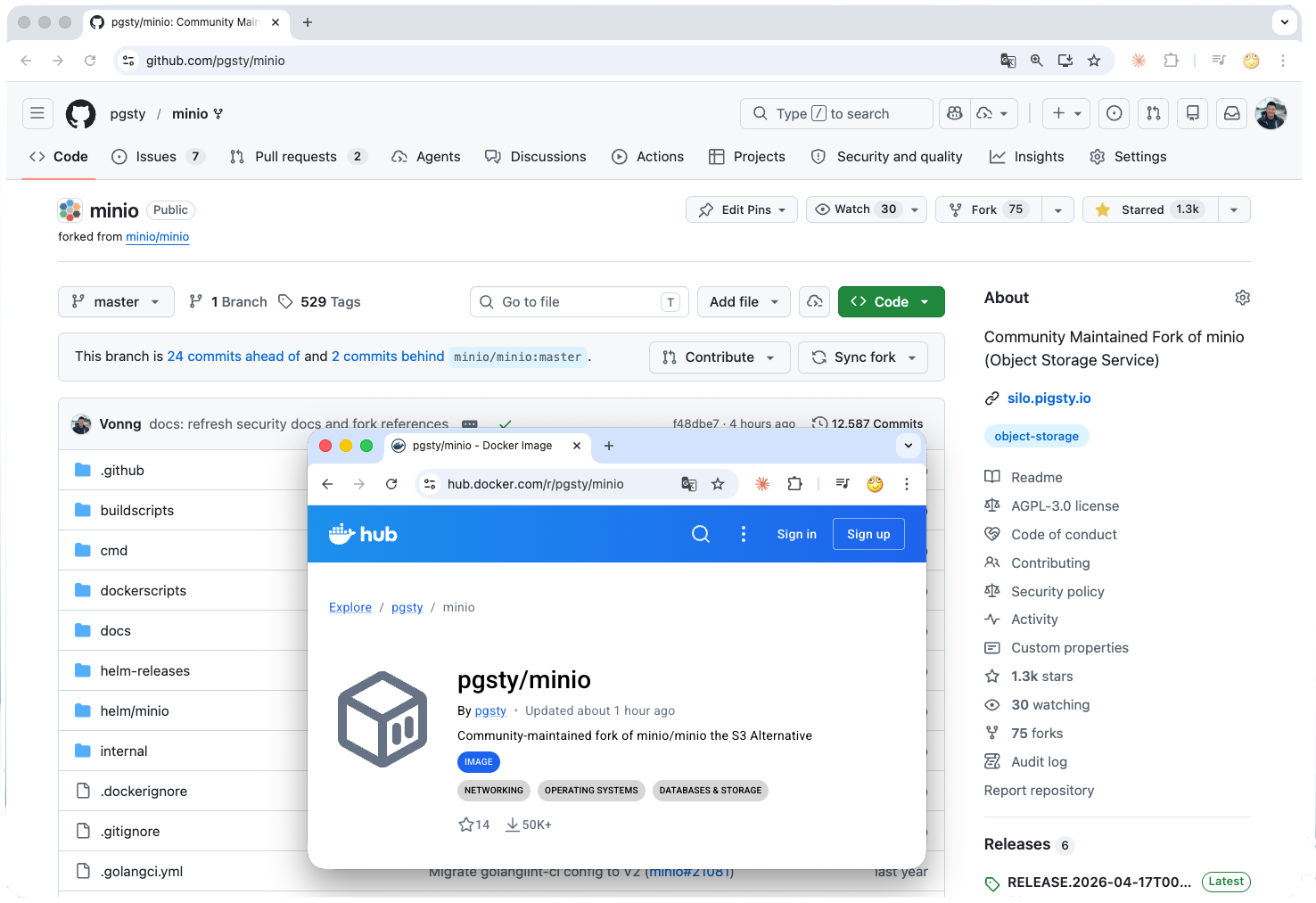
If you’re already running OSS MinIO, migration is cheap:
- Docker: swap
minio/minioforpgsty/minio. - RPM / DEB: on GitHub Releases, or via
pig. - Source: pgsty/minio
- Docs: silo.pgsty.com
You don’t need to replace anything around it or relearn the API. In most cases, you’re just pointing a compatible binary at the same deployment. If you want a full HA production setup, Pigsty ships one for free.
Something I use broke; I’m fixing it.
What’s different in 2026 is the cost of “I’m fixing it.” With two coding agents and someone to referee between them, the maintenance load of a mid-sized Go codebase is tractable for one person in a way it wasn’t a year or two ago. That’s about it — not a grand theory about open-source resilience, just the current operating point.
If you’re running OSS MinIO, the migration is cheap and the patches are current. If another CVE drops, I’ll still be here.
2 - MinIO Is Dead, Long Live MinIO
MinIO’s open-source repo has been officially archived. No more maintenance. End of an era — but open source doesn’t die that easily.
I created a MinIO fork, restored the admin console, rebuilt the binary distribution pipeline, and brought it back to life.
If you’re running MinIO, swap minio/minio for pgsty/minio.
Everything else stays the same. (CVE fixed, and the console GUI is back)
The Death Certificate
On December 3, 2025, MinIO announced “maintenance mode” on GitHub. I wrote about it in MinIO Is Dead.
On February 12, 2026, MinIO updated the repo status from “maintenance mode” to “no longer maintained”, then officially archived the repository. Read-only. No PRs, no issues, no contributions accepted. A project with 60k stars and over a billion Docker pulls became a digital tombstone.
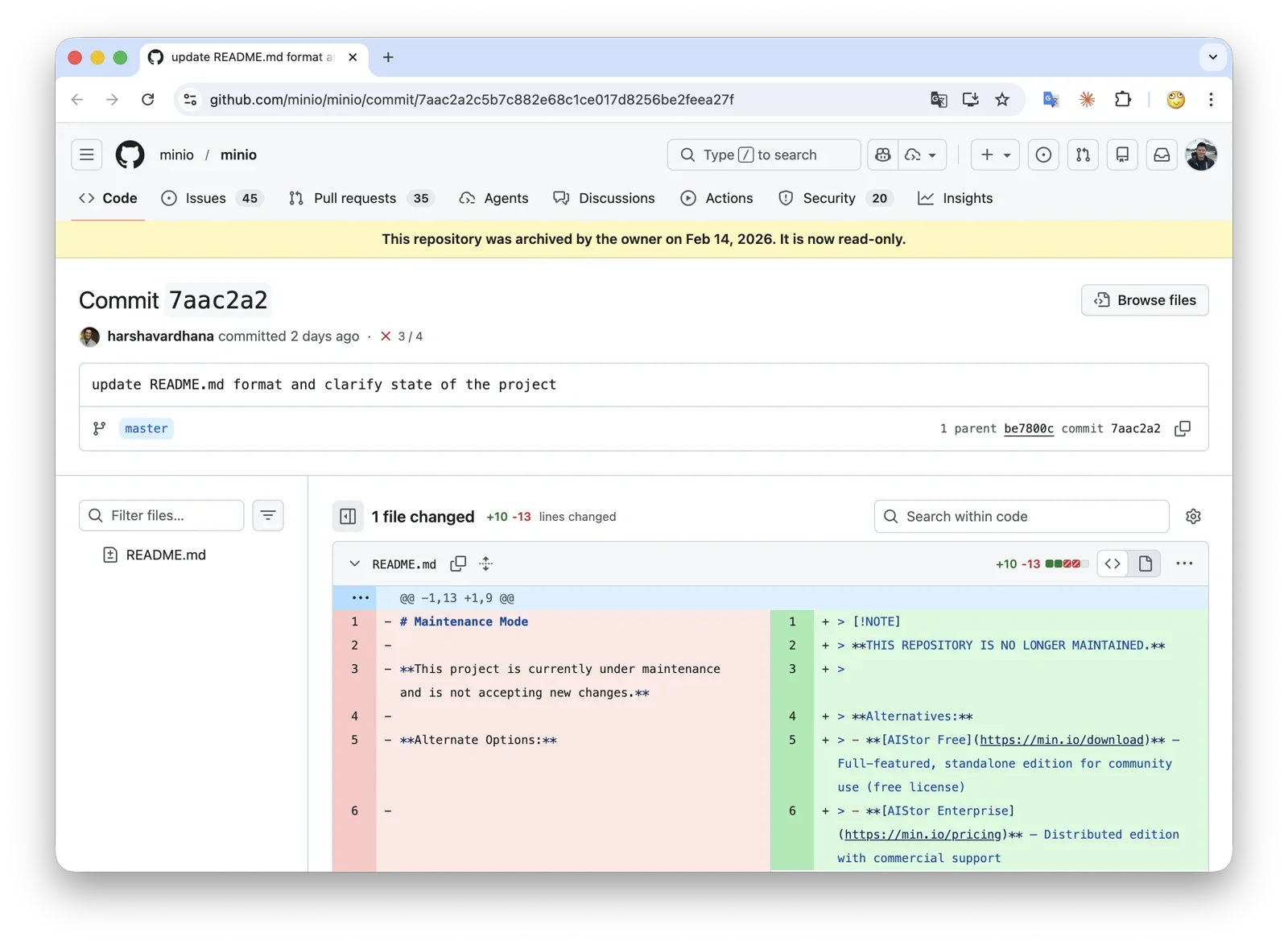
If December was the clinical death, this February commit was the death certificate.
Today (Feb 14), a widely circulated article titled How MinIO went from open source darling to cautionary tale laid out the full timeline.
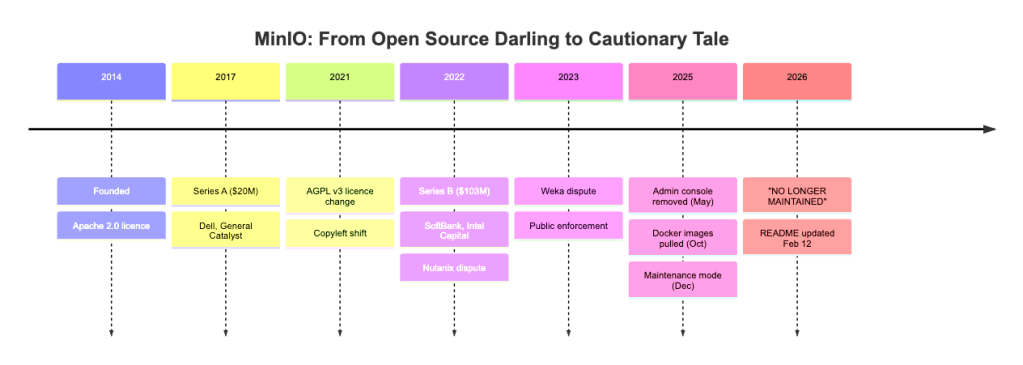
Percona founder Peter Zaitsev also raised concerns about open-source infrastructure sustainability on LinkedIn. The consensus in the international community is clear:
MinIO is done.
Looking back at the timeline over the past years, this wasn’t a sudden death. It was a slow, deliberate wind-down:
| Date | Event | Nature |
|---|---|---|
| 2021-05 | Apache 2.0 → AGPL v3 | License change |
| 2022-07 | Legal action against Nutanix | License enforcement |
| 2023-03 | Legal action against Weka | License enforcement |
| 2025-05 | Admin console removed from CE | Feature restriction |
| 2025-10 | Binary/Docker distribution stopped | Supply chain cut |
| 2025-12 | Maintenance mode announced | End-of-life signal |
| 2026-02 | Repo archived, no longer maintained | End of project |
A company that raised $126M at a billion-dollar valuation spent five years methodically dismantling the open-source ecosystem it built.
But Open Source Endures
Normally this is where the story ends — a collective sigh, and everyone moves on.
But I want to tell a different story. Not an obituary — a resurrection.
MinIO Inc. can archive a repo, but they can’t archive the rights that the AGPL grants to the community.
Ironically, AGPL was MinIO’s own choice. They switched from Apache 2.0 to AGPL to use it as leverage in their disputes with Nutanix and Weka — keeping the “open source” label while adding enforcement teeth. But open-source licenses cut both ways — the same license now guarantees the community’s right to fork.
Once code is released under AGPL, the license is irrevocable. You can set a repo to read-only, but you can’t claw back a granted license. That’s the beauty of open-source licensing by design: a company can abandon a project, but it can’t take the code with it.
So — MinIO is dead, but MinIO can live again.
That said, forking is the easy part. Anyone can click the Fork button. The real question isn’t “can we fork it” but “can someone actually maintain it as a production component?”
Why would I do that?
I didn’t set out to take this on. But after MinIO entered maintenance mode, I waited a couple of weeks for someone in the community to step up.
But I didn’t find one. So I did it myself.
Some background: I maintain Pigsty — a batteries-included PostgreSQL distribution with 460+ extensions, cross-built for 14 Linux distros. I also maintain build pipelines for 290 PG extensions, several PG forks, and dozens of Go Projects (Victoria, Prometheus, etc.) packaging across all major platforms. Adding one more to the pipeline was a piece of cake.
I’m not new to MinIO either. Back in 2018, we ran an internal MinIO fork at TanTan (back when it was still Apache 2.0), managing ~25 PB of data — one of the earliest and largest MinIO deployments in China at the time.
More importantly, MinIO is an optional module in Pigsty. Many users run it as the default backup repository for PostgreSQL in production. We did consider several alternatives, but none were a drop-in replacement for MinIO-based workflows.
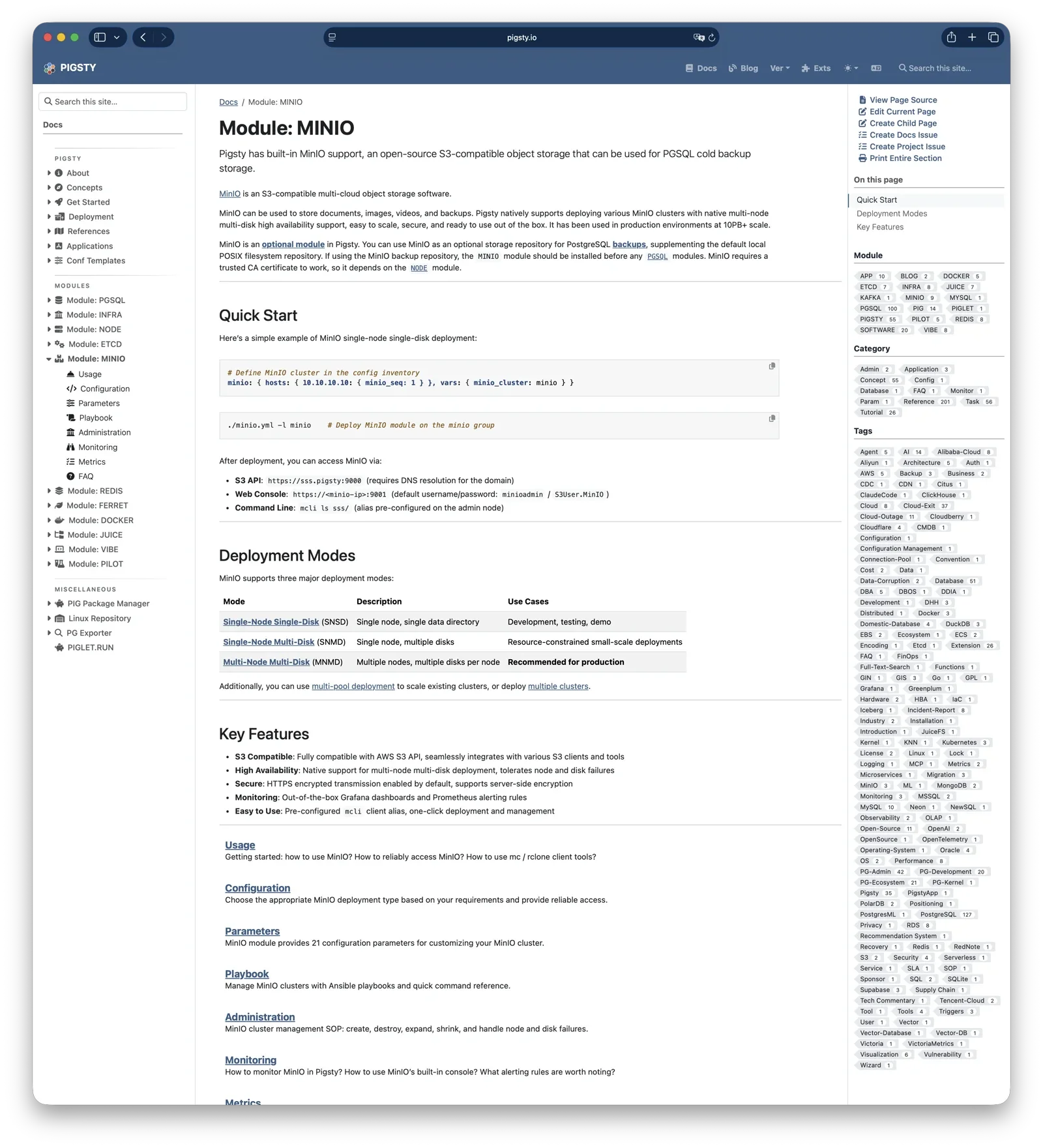
We use MinIO ourselves, so keeping the supply chain alive was not optional — it had to be done. As early as December 2025, when MinIO announced maintenance mode, I had already built CVE-patched binaries and switched to them.
What We’ve Done
As of today, three things.
1. Restored the Admin Console
This was the change that frustrated the community the most.
In May 2025, MinIO stripped the full admin console from the community edition, leaving behind a bare-bones object browser. User management, bucket policies, access control, lifecycle management — all gone overnight. Want them back? Pay for the enterprise edition. (~$100,000)
We brought it back.
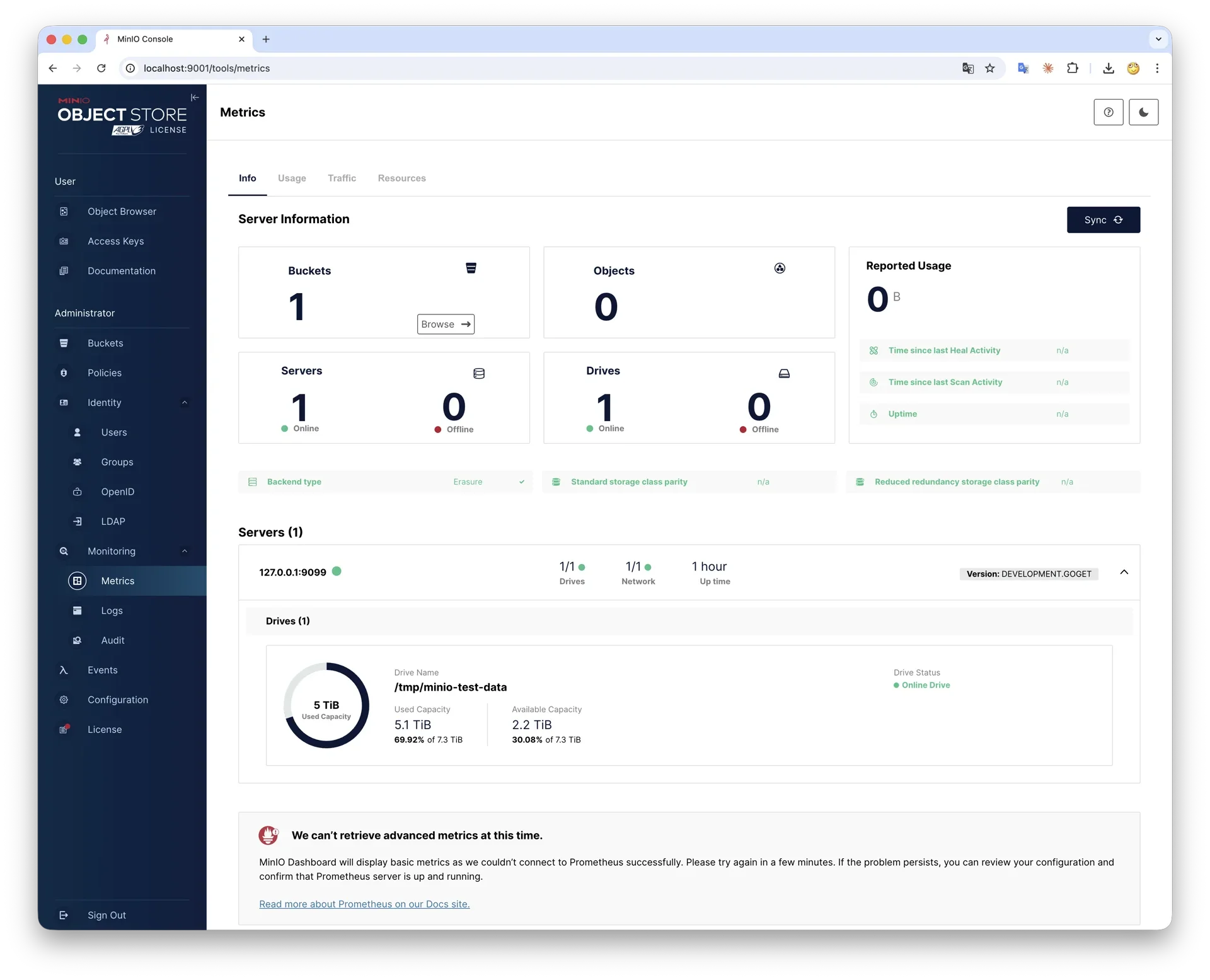
The ironic part: this didn’t even require reverse engineering.
You just revert the minio/console submodule to the previous version.
They swapped a dependency version to replace the full console with a stripped-down one. The code was always there.

We put it back.
2. Rebuilt Binary Distribution
In October 2025, MinIO stopped distributing pre-built binaries and Docker images,
leaving only source code. “Use go install to build it yourself” — that was their answer.
For the vast majority of users, the value of open-source software isn’t just a copy of the source — supply chain stability is what matters. You need a stable artifact you can put in a Dockerfile, an Ansible playbook, or a CI/CD pipeline — not a requirement to install a Go compiler before every deployment.
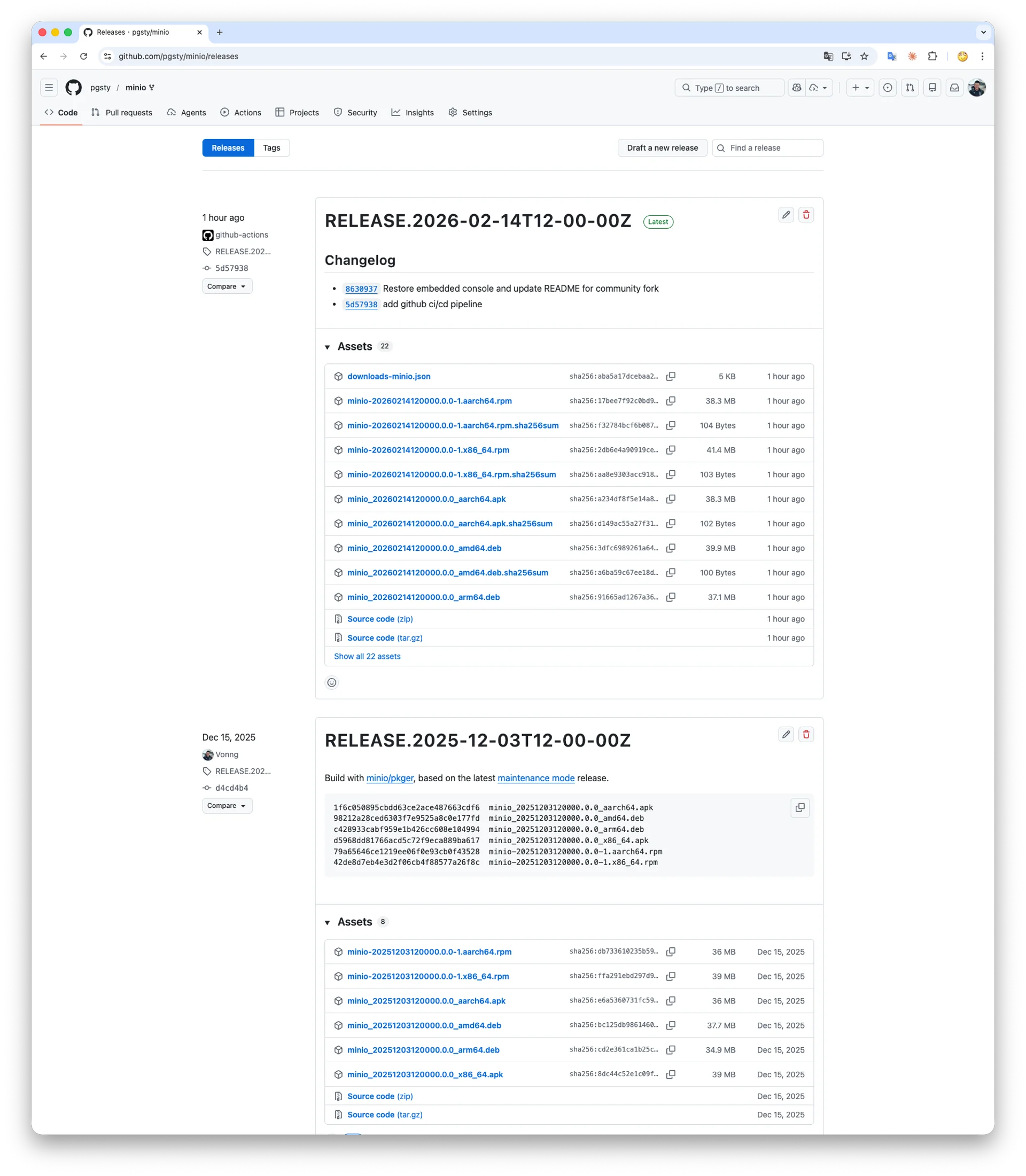
We rebuilt the distribution:
- Docker Images
pgsty/miniois live on Docker Hub.docker pull pgsty/minioand you’re good.- RPM / DEB Packages
- Built for major Linux distributions, matching the original package specs.
- CI/CD Pipeline
- Fully automated build workflows on GitHub, ensuring ongoing supply chain stability.
If you’re using Docker, just swap minio/minio for pgsty/minio.
For native Linux installs, grab RPM/DEB packages from the GitHub Release page. You can also use pig (the PG extension package manager) for easy installation, or configure the pigsty-infra APT/DNF repo to install from it:
Just works as usual.
3. Restored Community Edition Docs
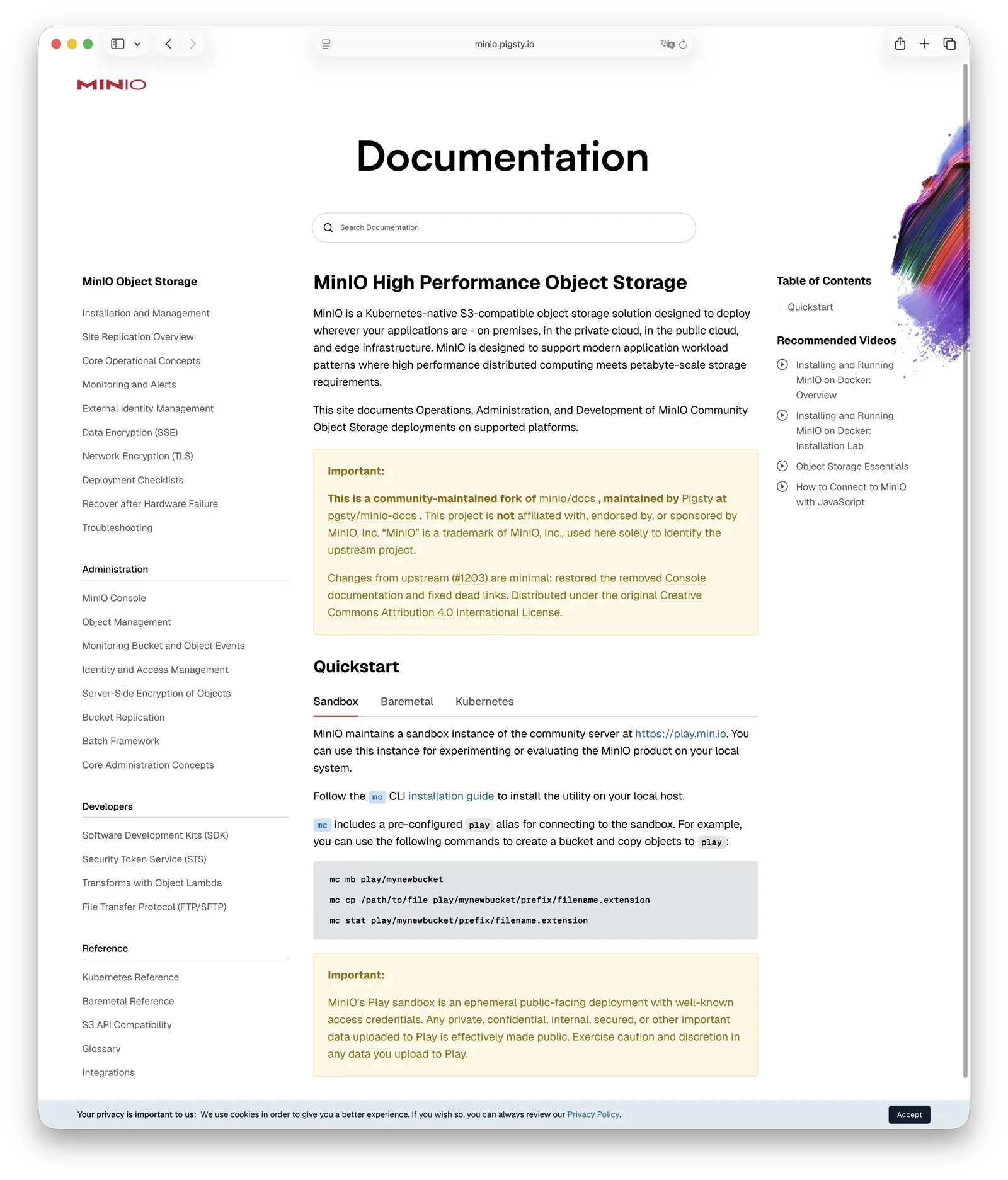
MinIO’s official documentation was also at risk — links had started redirecting to their commercial product, AIStor.
We forked minio/docs, fixed broken links, restored removed console documentation, and deployed it as the SILO documentation site.
The docs use the same CC Attribution 4.0 license as the original, with necessary maintenance.
Commitments
Some things worth stating up front to set expectations.
No New Features — Just Supply Chain Continuity
MinIO as an S3-compatible object store is already feature-complete. It’s a finished software. It doesn’t need more bells and whistles — it needs a stable, reliable, continuously available build. (I already have PostgreSQL for these, so I don’t need something like S3 table or S3 vector. A stable S3 core is all I need)
What we’re doing: making sure you can get a working, complete MinIO binary, with the admin console included and CVE fixed. RPM, DEB, Docker images — built automatically via CI/CD, drop-in compatible with your existing minio. We keep the existing minio naming and behavior where legally and technically feasible.
This Is a Production Build, Not an Archive
We run these builds ourselves and have been dogfooding them in production for three months. If something breaks, we detect it early and patch it quickly.
I build this primarily for Pigsty and our own usage, but I hope it helps others too.
I’m willing to Track CVEs and Fix Bugs
If you run into issues, feel free to report them at pgsty/minio.
I’ll do my best to fix these — but please don’t treat this as a commercial SLA.
Given that AI coding tools have made bug fixing dramatically cheaper, and that we’re explicitly not adding any new features, I believe the maintenance workload is manageable. (how often do you see one?)
Trademark Is Tricky, But We’ll Cross That Bridge When We Come to It
Disclaimer
Trademark Notice: MinIO® is a registered trademark of MinIO, Inc. This project (pgsty/minio) is an independently maintained community fork under the AGPL license. It has no affiliation with, endorsement by, or connection to MinIO, Inc. Use of “MinIO” in this post refers solely to the open-source software project itself and implies no commercial association.
AGPLv3 gives us clear rights to fork and distribute, but trademark law is a separate domain. We’ve marked this clearly everywhere as an independent community-maintained build.
If MinIO Inc. raises trademark concerns, we’ll cooperate and rename (probably something like silo or stow).
Until then, we think descriptive use of the original name in an AGPL fork is reasonable — and renaming all the minio references doesn’t serve users.
AI Changed the Game
You might ask: can one person really maintain this?
It’s 2026. Things are different now.
AI coding tools are changing the economics of open-source maintenance.
With tools like Claude Code & Codex, the cost of locating and fixing bugs in a complex Go project has dropped by more than an order of magnitude. What used to require a dedicated team to maintain a complex infra project can now be handled by one experienced engineer with an AI copilot.
Maintaining a MinIO build without adding new features is a manageable task. The key requirement is testing and validation. and we already have that scenario, which lets us verify compatibility, reliability, and security in practice.
Consider: Elon cut X/Twitter’s engineering team down to ~30 people and the system still runs. Maintaining a MinIO fork without new features is considerably less daunting
Just Fork It
MinIO Inc. can archive a GitHub repo, but they can’t archive the demand behind 60k stars, or the dependency graph behind a billion Docker pulls. That demand doesn’t disappear — it just finds its way out.
HashiCorp’s Terraform got forked into OpenTofu, and it’s doing fine. MinIO’s situation is actually more favorable —
AGPL is more permissive for forks than BSL, with no legal gray area for community forks.
A company can abandon a project, but open-source licenses are specifically designed so the code can’t die.
Fork is the most powerful spell in open source. When a company decides to shut the door, the community only needs two words:
Fork it.
Reference
- MinIO Is Dead
- MinIO Is Dead, Are There Alternatives?
- From AGPL to Apache: Reflections on Pigsty’s License Change
- MinIO: Promise made, Promise kept
3 - MinIO Is Dead. Which Next?
MinIO announced maintenance mode two days ago. I ranted in “MinIO Is Dead” and immediately got flooded with “so what now?”
The usual suspects: Ceph, RustFS, SeaweedFS, Garage. I packaged all of them for Linux (RPM/DEB) and ran them through the grinder.
Short version: there’s no perfect substitute. Ceph is powerful but overkill; SeaweedFS rocks tiny files but needs an external metadata DB; Garage is cute but too barebones; RustFS targets the MinIO niche but is still alpha.
Quick scan of the field
MinIO is the open-source S3 clone. If all you need is basic object CRUD, any S3-compatible store works. But parity with MinIO means more than APIs—it’s about reliability, operability, tooling, documentation, SOPs. Replacing it cleanly is hard.
Ignoring commercial clouds, here’s the OSS menu:
- Ceph – arguably the best choice for enterprises, but brutally complex. Most folks don’t need block + file + object in one, and it requires extras like Podmon. MinIO’s single binary spoiled us.
- SeaweedFS – optimized for oceans of small files; O(1) disk seeks make it absurdly fast there. But it relies on an external metadata store. If you want a general-purpose object store, that dependency is annoying.
- Garage – built by Deuxfleurs with NGI funding. Delightfully light (10 MB), great for self-hosters and edge nodes. But S3 compatibility is thin: no versioning, no cross-region replication, no IAM. Enterprises will laugh.
- RustFS – the only project explicitly chasing “drop-in MinIO,” but it’s still alpha.
RustFS vs. MinIO
RustFS looked the most promising, so I wired it into Pigsty as a MinIO replacement. Most logic carried over, but a few differences popped up:
- Certificates must follow specific naming rules.
- Health checks differ from MinIO’s endpoints.
mc admindoesn’t work; you can’t push fine-grained IAM policies. That’s a deal-breaker for many teams.
It ran, but I’m not shipping alpha software into production, so I shelved the branch. I’ll revisit when RustFS hits GA.
Will RustFS repeat MinIO’s mistakes?
RustFS has potential, but I worry it’ll retrace MinIO’s path. I asked the AI big three (GPT‑5 Pro, Claude 4 Opus, Gemini 3 Pro) to audit the project. Gemini leveled some serious accusations; Claude corroborated.
The red flags match MinIO’s history: Apache 2.0 license + copyright assignment CLA + single commercial gatekeeper. With that risk profile, I’m downgrading RustFS from “optimistic” to “cautious wait-and-see.”
So what now?
Pigsty bundles MinIO as an optional module for PostgreSQL backups or as an on-prem S3 for apps like Supabase. After surveying the alternatives, I’m not eager to swap it out. I might add a pgBackRest-native backup server option, but ripping out MinIO today feels premature.
Best plan: stay on the latest MinIO release, lock the version, isolate it on the network, and wait a few months. Maybe the community forks it; maybe RustFS matures. Adjust when reality changes.
RustFS still has a golden window to seize MinIO’s niche with a safer, community-friendly fork. That window is measured in months, not years.
If you stick with MinIO
Use the latest build, not the April 22, 2025 edition with the GUI. There’s a serious CVE in the interim:
- CVE-2025-62506 – privilege escalation via session-policy bypass (HIGH). Low-privilege users can mint new accounts and escalate.
In a locked-down intranet the risk is manageable, but you still want the fix, which landed in the 2025‑10‑15 release. MinIO pulled the prebuilt binaries starting with that version, offering source only. Annoying, but it’s Go—go build and you’re done. I forked MinIO, ran their packager, and produced RPM/DEBs for 2025‑12‑03 so I’m not deploying vulnerable bits: https://github.com/pgsty/minio
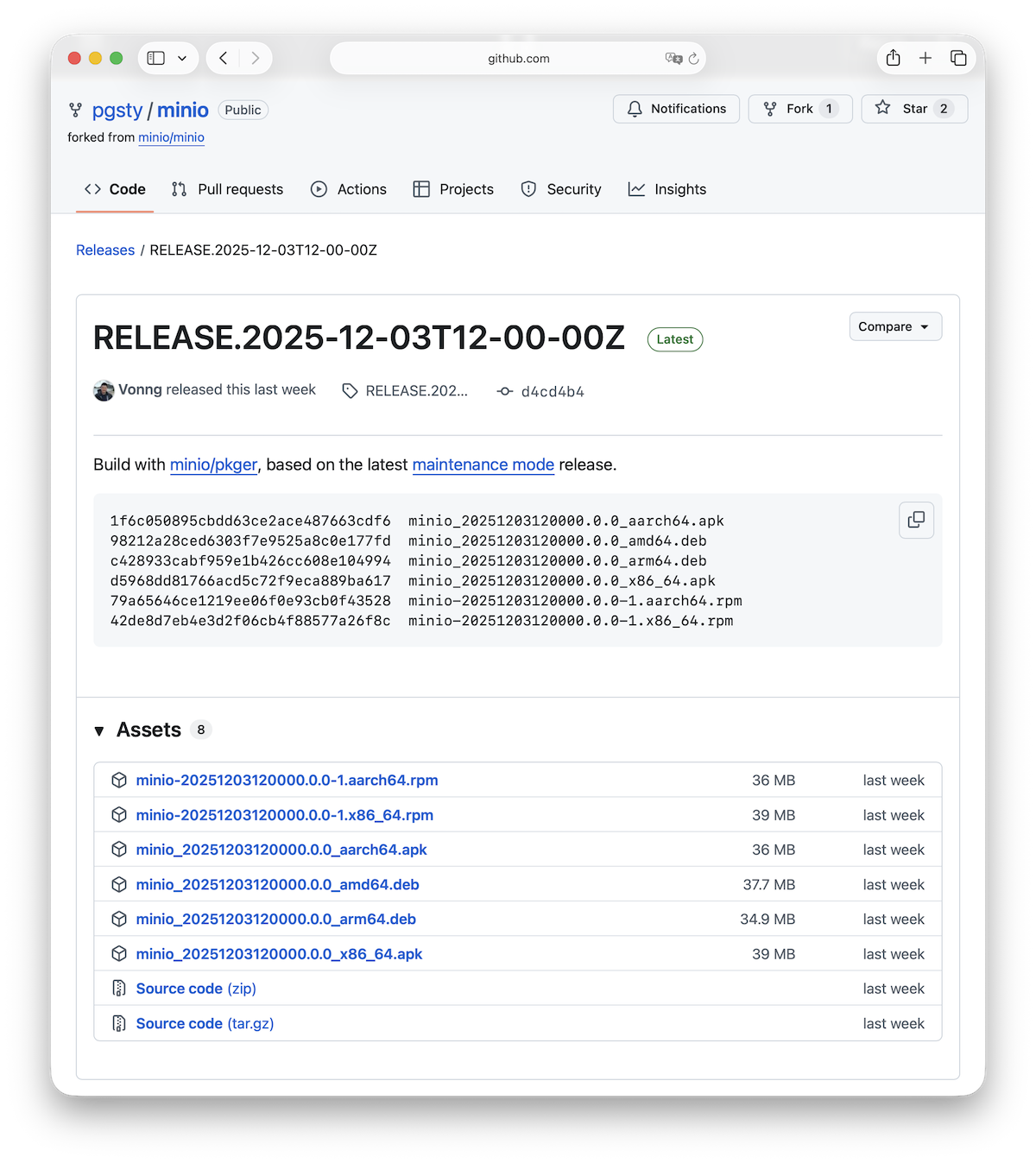
Security patches still need humans. MinIO claims they’ll fix critical issues, but if the community wants a maintained fork, now’s the moment. Start from 2025‑04‑22, cherry-pick critical bug/security fixes, and keep a community LTS alive.
MinIO is “done” software. It doesn’t need the latest S3 gimmick (Vector/Table); it needs steady bugfixes. That’s perfect for a community branch. Plenty of storage vendors rely on MinIO; maintaining a fork beats writing a new object store from scratch.
2026-02-14 Update: MinIO’s official repo has been fully archived and is no longer maintained. Besides, I’ve personally maintained an oss fork of minio:
pgsty/minio/ Docs: https://silo.pgsty.com. Which based on the last upstream version 2025-12-03 with restored console capabilities.
4 - MinIO is Dead
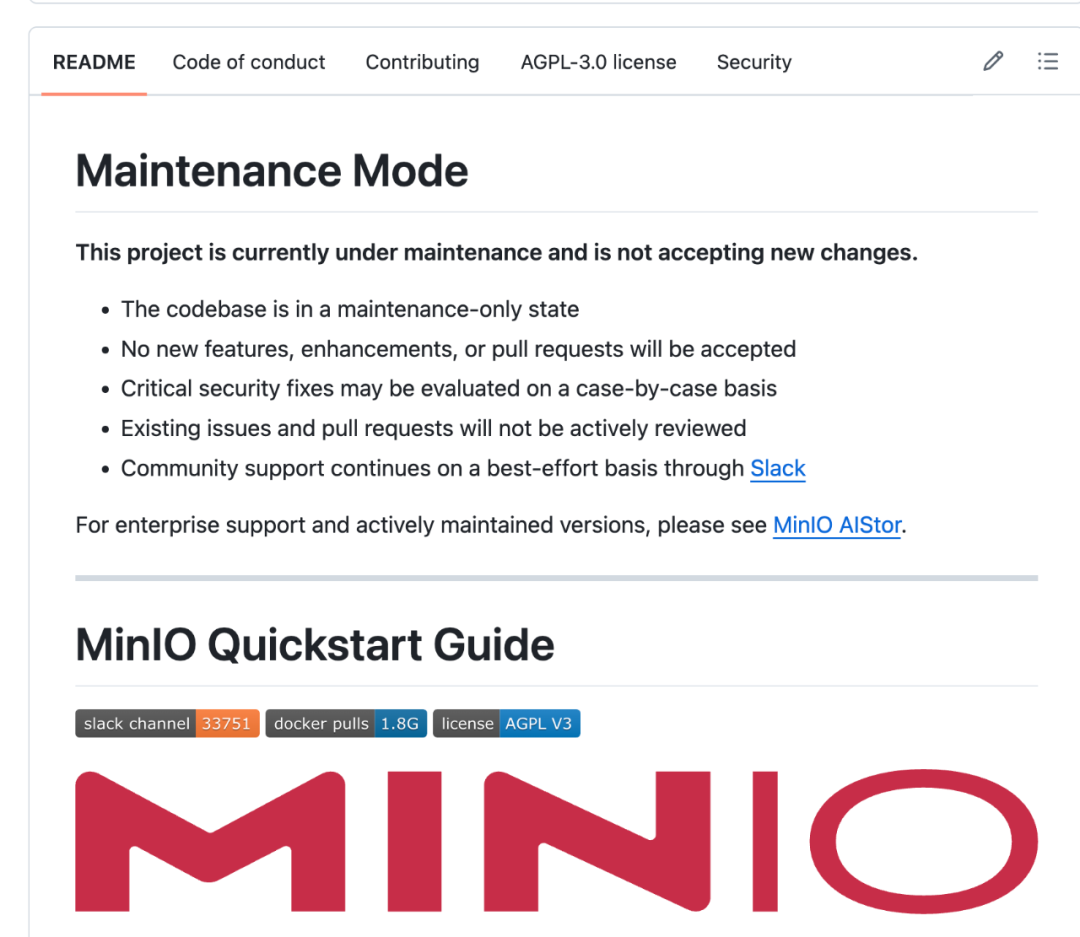
December 3, 2025 was a day to mark in open-source software history. MinIO’s team updated the project status on GitHub, announcing the MinIO open-source project was entering “maintenance mode.” This basically declared the death of MinIO as an open-source project.
MinIO the company has finally completed its transformation from a dragon-slaying hero into the very dragon it once sought to slay.
From Dragon-Slayer to Dragon
Democratization Era (2014–2019): The Apache of Object Storage
MinIO was founded in 2014 with a highly idealistic vision – to be “the Apache of object storage.” In an era dominated by AWS S3, MinIO’s ultra-lightweight design (a single static binary) and 100% S3 API compatibility quickly won developers’ hearts.
During this phase, MinIO was licensed under the liberal Apache 2.0 license, encouraging developers to integrate it into all kinds of applications. Its core pitch: “turn any hardware into AWS S3.” This open strategy was wildly successful. MinIO claimed its Docker image had been pulled over 1 billion times, making it the world’s most widely deployed object storage service. At this point, MinIO was a darling of the cloud-native stack – the default storage backend in many Kubernetes setups.
License Weaponization (2019–2025): The AGPL War
The first major crack in community relations appeared around 2019–2021. MinIO announced it was changing its core license from Apache 2.0 to GNU AGPLv3.
The official explanation was that this move aimed to prevent cloud providers (like AWS, Azure) from “freeloading” the code and repackaging it as proprietary services — a common defensive tactic in open source. During this period, MinIO shifted from being a community guardian to an aggressive defender of its IP. In 2022, MinIO publicly accused Nutanix Objects of violating its license and revoked Nutanix’s right to use MinIO; in 2023, MinIO sued high-performance filesystem vendor Weka on similar grounds. These legal actions, though legally contentious, sent a clear signal: MinIO no longer welcomed commercial use without paying up. This set the legal and psychological stage for the full lockdown that would come in 2025.
Control Plane Neutered (May 2025)
In May 2025, MinIO decided to strip the MinIO Console out of the community edition. The console was a critical GUI for bucket management, IAM, monitoring, and audit logging. After this removal, the open-source MinIO was left with only a basic “object browser” GUI – essentially just a file viewer/downloader.
Meanwhile, key admin features like policy management, site replication configuration, and lifecycle management were moved entirely into the commercial enterprise edition. This change downgraded the open-source MinIO from a full-featured storage management system into a mere data-plane component, robbing it of the control-plane capabilities needed to run as a standalone product in production.
Cutting Off Binary Distribution (Oct 2025)
On October 15, 2025 – right as a critical security vulnerability (CVE-2025-10-15T17-29-55Z / GHSA-jjjj-jwhf-8rgr) was disclosed – MinIO stopped publishing updated Docker images to Docker Hub and Quay.io. The timing of this move was highly strategic. By cutting off binaries during a major security incident, MinIO effectively used security as a bargaining chip.
This decision directly broke the automated deployment pipelines for countless users. Helm charts, Ansible playbooks, and Terraform scripts expecting minio/minio (or Bitnami’s minio) image suddenly failed to find updates.
Auto-scaling groups trying to pull new nodes hung due to missing images. For teams without a Go build environment or an internal container registry, MinIO instantly became unusable.
Maintenance Mode (Dec 2025)
On December 3, 2025, MinIO, Inc. officially updated its channels and GitHub repo to announce that the open-source project is now in “maintenance mode.” The README stated that there will be no further feature additions or improvements, issues and PRs will no longer be reviewed, and even critical security fixes would be provided “as appropriate.” No more RPM/DEB packages or Docker images will be released. Essentially, anyone needing updates or support is advised to switch to the commercial AIStor product.
Technical Impact: Damage to the Open-Source Ecosystem
MinIO’s move to maintenance mode dealt an immediate and far-reaching blow to many tech stacks.
Broken CI/CD Pipelines and an Automation Crisis
Thousands of Helm charts, Ansible playbooks, and Terraform scripts depend on the minio/minio (or Bitnami’s minio) container image.
With official images no longer published, third-party packagers like Bitnami — who can’t get a stable upstream release — also had to stop updates.
- Cascade effect: Deployments in fresh environments started failing outright. Auto-scaling groups, upon launching new instances, would hang or error out when the MinIO image couldn’t be pulled.
- Cost of fixes: Companies now have to rewrite their deployment scripts to point to a self-hosted image, and set up internal build pipelines to compile and package MinIO from source.
Security Vacuum: CVE Patches Go Private
The most lethal consequence of halting binary distribution is delayed security patches. In the October 2025 incident, for example, MinIO effectively withheld the patched binaries for the vulnerability.
- Risk exposure: Companies without dedicated security teams are forced to keep running older, vulnerable versions with known critical flaws.
- Compliance nightmare: For organizations under PCI-DSS, HIPAA, SOC2, etc., not being able to obtain vendor-signed security updates is a compliance disaster. Lacking official patches, they technically fall out of compliance.
Exponentially Higher Ops Complexity
Removing the UI wasn’t just a hit to user experience – it increased operational burden.
Tasks that used to be a few clicks in the Console (configuring bucket policies, setting user permissions) now require ops engineers to master the mc CLI or hand-craft complex JSON policy docs.
This raises the skill floor and makes MinIO far less friendly as a lightweight internal tool.
Underlying Reasons: Pressure from Capital and Commercialization
The driving force behind MinIO’s decisions is the logic of venture capital. By 2025, MinIO had raised a total of $126 million in funding. The most significant was a $103 million Series B in January 2022 led by Intel Capital, SoftBank Vision Fund II, and General Catalyst, which crowned MinIO a unicorn (valued over $1 billion).
In VC terms, a $1B valuation means the company must show a clear path to IPO — typically demanding $100M+ in Annual Recurring Revenue (ARR) and rapid growth. In Feb 2025, MinIO announced its ARR had grown 149% over the past two years businesswire.com. Impressive growth, but to live up to a sky-high valuation, organic conversion alone wasn’t enough.
Cutting off the free open-source offering is the most direct way to force a huge user base into paid customers.
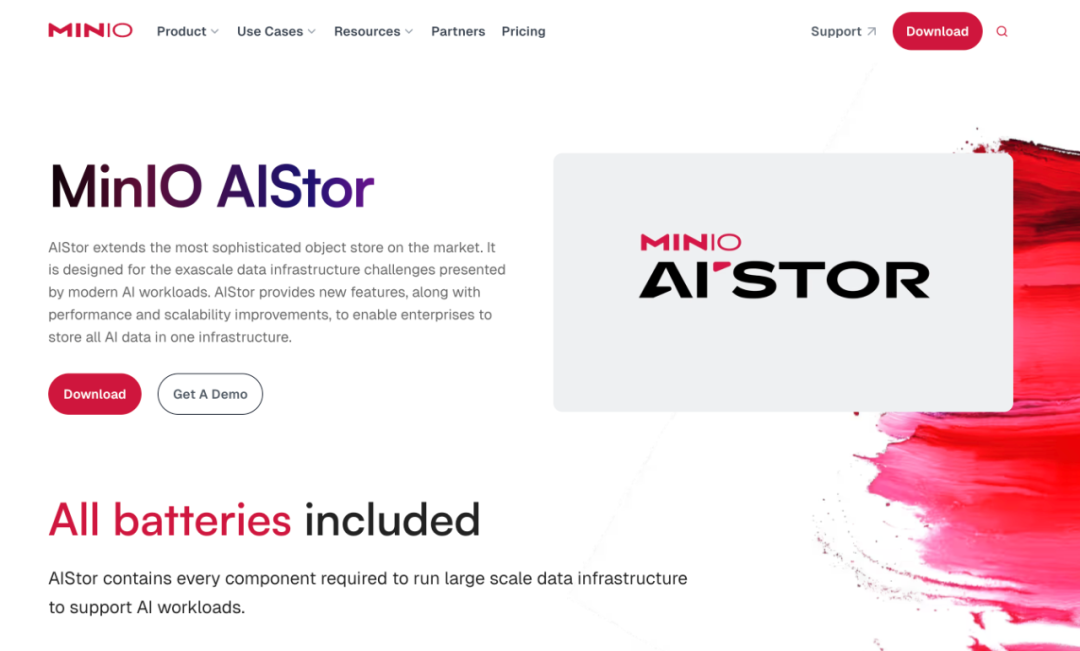
In 2025, MinIO underwent a full rebrand and launched “MinIO AIStor,” styling itself as “the data backbone for enterprise AI.” Management recognized that general-purpose object storage (for backups, file servers, etc.) was a red-ocean market with thin margins, whereas generative AI’s appetite for high-throughput data (the exascale AI era) promised the next big surge. By tuning its product for AI workloads and focusing on Fortune 500 enterprises linkedin.com, MinIO essentially decided to cut loose its low-value open-source user base. The move to maintenance mode signaled MinIO’s official pivot from a broad open-source project into a vertical, high-end AI software vendor.
MinIO isn’t a garage hobby project by a few geeks anymore; it’s a company that took $126M in VC and is valued at over $1B. Backed by Intel Capital and SoftBank, once you take that money, your boss is no longer the users — it’s the investors. And what do investors want? ARR, growth, IPO. You tell them, “We have a billion Docker pulls!” and they’ll ask, “How many dimes did those pulls pay us?”
The reality is brutal. To the VCs, those small businesses and individual devs using free MinIO are low-value assets. They open issues and ask for support — consuming expensive engineer time, bandwidth, and servers — yet will never convert to paying customers. MinIO’s leadership knows their real cash cows are the Fortune 500 firms doing generative AI. The ones training GPT models or running self-driving pipelines need AIStor, ultra-high performance, and 24/7 enterprise SLAs.
So flipping the project into “maintenance mode” is essentially an asset carve-out. MinIO is cutting away the “dead weight” (free users) and concentrating on the milkable “cash cows” (enterprise AI clients). In business strategy this is called focus. To the investors, it’s being responsible. But from the perspective of open source, it’s simply betrayal.
Personal Reflections
I started using MinIO around 2018 (back when it was Apache-licensed). We built a few multi-petabyte object storage clusters for videos, images, backups — probably one of the largest MinIO deployments in China at the time. I wrote deployment/monitoring playbooks for MinIO (still open-sourced in Pigsty).
As an open-source startup founder, I can understand the motivation behind these moves. But as an open-source contributor and user — I also know many folks right now have one phrase in their minds: “I have never seen such shamelessness.”
An open-source license isn’t a shackle, but it is a social contract. Developers contribute code, users contribute testing, feedback, and reputation; together, they make a project successful. MinIO enjoyed a decade of community goodwill and parlayed the bragging rights of “#1 in global downloads” into venture funding. Then it turned around and told the very users who propped it up: “You free-riders, get lost.” This kind of move breaks the fundamental trust that open source is built on.
This “bait and switch” tactic is even more nauseating than a crypto rug pull. A rug pull only takes your money — MinIO is pulling the rug out from under the tech stacks of thousands of companies. Adopting a technology isn’t just picking up a binary; it’s buying into an ecosystem and a design philosophy. They got everyone onboard, let the switching costs pile up sky-high, and then suddenly kicked away the ladder. In fact, as open-source expert Tison thoroughly discussed in his article The Bait-and-Switch Open-Source Strategy, the core issue with this model is deception.
MinIO betrayed the community, so the community may abandon it as well. Alternatives like Garage, SeaweedFS, or the new RustFS are ready to step in.
If I have to sum up my feelings, I’d borrow a line from The Hitchhiker’s Guide to the Galaxy:
—— “So long, and thanks for all the fish.”
2026-02-14 Update: MinIO’s official repo has been fully archived and is no longer maintained. Besides, I’ve personally maintained an oss fork of minio:
pgsty/minio/ Docs: https://silo.pgsty.com. Which based on the last upstream version 2025-12-03 with restored console capabilities.